
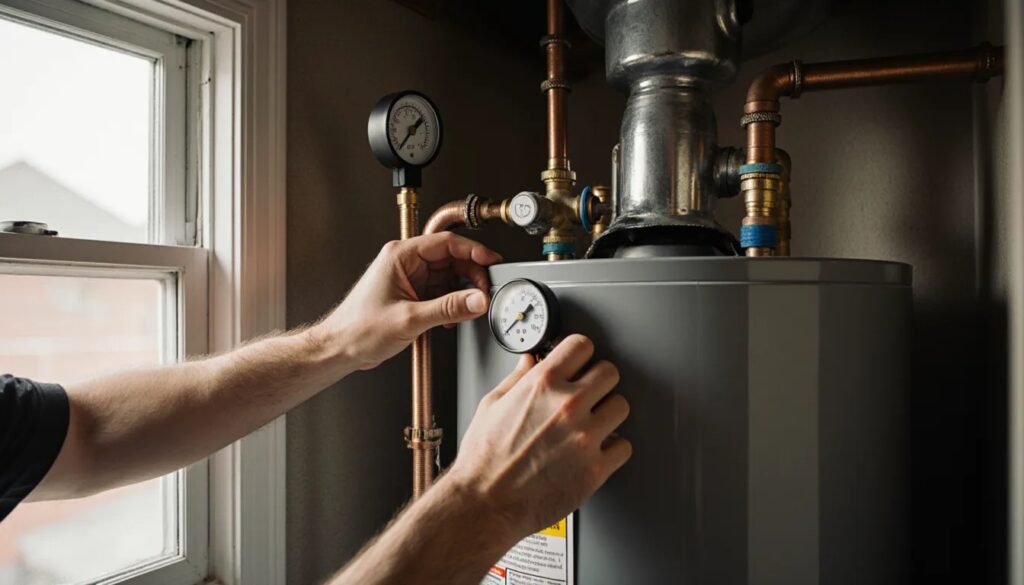
If your water heater is leaking, running cold, or making a rumble like a kettle full of gravel, you are usually facing one decision: pay to fix it, or pay to replace it. The right answer is not always the cheaper repair. It depends on the age of the tank, what actually failed, and how much longer the unit was going to last anyway.
Here is how to think it through the way an honest plumber would, before you approve a single dollar of work.
Quick Answer
Repair your water heater if it is under about 8 years old and the problem is a minor part like a thermostat, heating element, or valve. Replace it if it is past 8–10 years, the tank itself is leaking, or a repair would cost more than about half the price of a new unit. A leaking tank is not repairable — that is always a replacement.
How long does a water heater last?
A standard tank water heater lasts roughly 8 to 12 years. A well-maintained unit with an intact anode rod can push past that; one in an area with hard water may fail sooner. Tankless units often last 20 years or more. Age is the single most useful number in the repair-versus-replace decision, so find the manufacture date first — it is usually encoded in the serial number on the label.
When repairing makes sense
If the tank is relatively young and the failed part is a component rather than the tank body, a repair is usually the smart money. Common repairable issues include:
- No hot water on an electric unit — often a failed heating element or thermostat, typically an inexpensive fix.
- No hot water on a gas unit — frequently a bad thermocouple, pilot, or gas control valve.
- Not enough hot water or it runs out fast — can be a dip tube or lower element issue.
- A leaking drain valve or a failed temperature-and-pressure (T&P) relief valve — both are replaceable parts, not the tank.
As a rough guide, most component repairs land somewhere in the low hundreds of dollars. If the unit is under warranty, the part may be covered even if the labor is not — always check before paying out of pocket.
When replacement is the better call
Some symptoms point past repair. Replace the unit when:
- The tank itself is leaking. Water seeping from the body means the steel has corroded through. No repair fixes that.
- It is past 8–10 years. Even a successful repair buys limited time, and you risk paying twice.
- Rusty or metallic-smelling hot water. Corrosion inside the tank is advanced.
- Rumbling or popping sounds. Sediment has hardened on the bottom, making the unit work harder and fail faster.
- The repair quote approaches half the cost of a new unit. At that point you are throwing good money after old equipment.
There is also an efficiency angle. A tank from the mid-2010s or earlier is often meaningfully less efficient than a current model, so replacement can trim monthly energy costs on top of ending the repair cycle.
If you replace: tank or tankless?
A conventional tank is cheaper up front and simpler to install like-for-like. A tankless (on-demand) unit costs more to install — sometimes substantially, because it can require gas-line or venting upgrades — but heats water only when you need it, lasts longer, and never runs out mid-shower. If your current setup already struggles to keep up with the household, that is a reason to consider tankless rather than replacing one undersized tank with another.
What water heater replacement costs in 2026
Prices vary widely by region, fuel type, and how much the install involves, so treat these as ranges rather than quotes. A standard 40–50 gallon tank unit installed generally runs in the low-to-mid four figures. Tankless installations typically run higher — often several thousand dollars — once you factor in venting, gas capacity, or electrical work. What moves the number most is labor complexity: tight access, code-required upgrades (expansion tanks, new venting, a drain pan), and permit fees. When you compare quotes, make sure each one covers the same scope, not just the appliance. Our guide on comparing contractor estimates walks through how to line up bids fairly.
A real-world moment
Picture a Saturday morning: lukewarm shower, a faint smell of rust, and a small ring of water under the tank. A homeowner calls two plumbers. One says “replace it, it’s 11 years old and the tank’s weeping.” The other offers to “just swap the element” for a few hundred dollars. The second quote is cheaper today, but the tank — the one part that cannot be repaired — is already failing. Spending on an element here is spending on a unit that is on its way out. The age and the tank leak together make replacement the honest recommendation.
Mistakes to avoid
- Approving a repair without asking the unit’s age — it changes everything.
- Ignoring a small tank leak. It does not seal back up; it gets worse, sometimes suddenly.
- Replacing a tank with the same undersized model when the household keeps running out of hot water.
- Skipping the permit or the code upgrades a cheap bid leaves out — you inherit those problems later.
- Paying for a part that is still under manufacturer warranty.
Frequently asked questions
Is it worth repairing a 10-year-old water heater?
Usually not, unless the fix is very minor and cheap. At 10 years a tank unit is near the end of its expected life, so a repair often buys only a little time before you are replacing it anyway. If the tank is leaking, replacement is the only real option.
Can a leaking water heater be repaired?
It depends on where it leaks. A leak from the drain valve, the T&P relief valve, or a fitting can often be repaired. A leak from the tank body itself cannot — that means the steel has corroded through and the unit needs replacing.
How much does it cost to replace a water heater in 2026?
A standard tank unit installed typically runs in the low-to-mid four figures, while tankless installations often run several thousand dollars once venting, gas, or electrical upgrades are included. Local labor rates and code requirements move the price the most, so compare quotes on identical scope.
How do I know how old my water heater is?
Check the serial number on the manufacturer label. Most brands encode the manufacture date in it — often the first letters or digits represent the month and year. If you cannot decode it, the brand’s website or a plumber can.
Does homeowners insurance cover water heater replacement?
Insurance generally does not pay to replace a water heater that failed from age or wear, but it may cover sudden water damage the failure causes to your home. Coverage varies, so read your policy and see our guide on whether homeowners insurance covers water damage.
The bottom line
Let the age and the failure point lead the decision. Under 8 years with a bad part? Repair it. Past a decade, a leaking tank, or a repair bill creeping toward half the price of new? Replace it — and size the new unit to how your household actually uses hot water. When you gather quotes, insist that each plumber explains what failed and why their fix is the right one. That transparency is the difference between a fair price and an expensive guess.
Comparing local plumbers? Browse plumbers on Powered By The People and weigh them using real, aggregated reviews. For related reading, see how much plumbing repair costs in 2026, the signs of a hidden water leak, and what homeowners insurance covers when water damage strikes. More guides are in the plumbing section.